


Published April 20, 2026
Idaho Falls & East Idaho Real Estate Market Update — What the Numbers Actually Say | Ep. 05 — The Success Blueprint

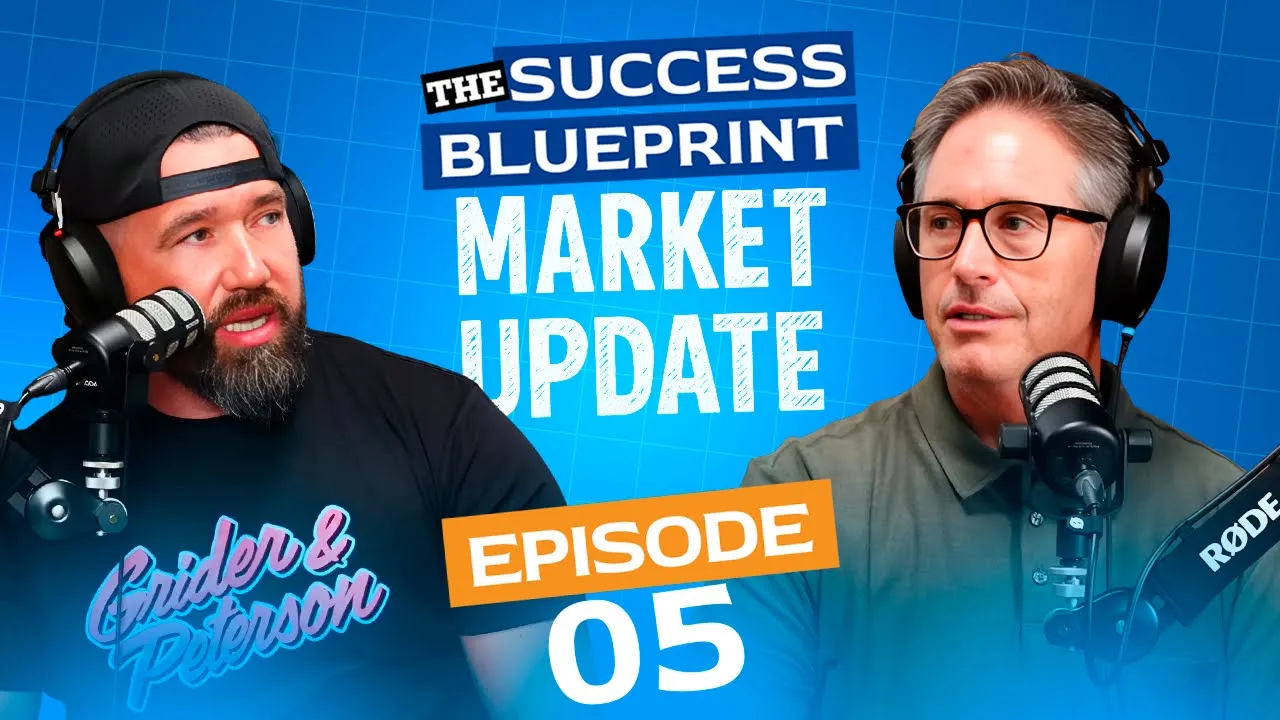
When someone asks "how's the market?" the honest answer is never one sentence. In Episode 5 of The Success Blueprint Podcast, Jason Grider and Morgan Peterson skip the small talk and go straight to the data — national trends, state-level job growth, local Bonneville County stats, and the one number that explains almost everything happening in East Idaho real estate right now.
This is the episode for anyone who wants to actually understand the market they're buying or selling in — not just hear that it's "pretty good" or "a little slow."
The national picture is more stable than headlines suggest. Delinquency and foreclosure rates are currently near pre-2000 levels — historically low — and the brief COVID-era spike dropped off quickly. Part of what's holding that down is the interest rate lock-in effect: millions of homeowners who locked in 2-3% rates aren't moving, which is suppressing existing home sales nationally to just over 4 million per year, down from a peak of over 6 million. That's a 30% drop that has held steady since 2022. The offset has been new construction, which has increased — but it hasn't fully replaced the volume lost on the existing home side.
Idaho continues to lead the country in job growth. The state ranks number one nationally in employment gains since March 2020, with a 14.2% change through May 2025. Utah is second. While the Boise metro captures most of that growth, East Idaho is still seeing meaningful expansion, and the migration patterns driving it — remote workers choosing lifestyle over location, businesses following population — show no signs of reversing. Western home prices have risen dramatically as a result, and what was once one of the more affordable regions in the country now surprises people relocating from the Midwest.
Locally in Bonneville County, the picture is nuanced. Sales volume is down about 20% from peak, but year-to-date numbers are up 10% — meaning East Idaho is recovering faster than the national market, which is still looking at 1996-era transaction volumes. The average sold price in Bonneville County is currently $428,000. The sale-to-list ratio is holding at 99%, which means homes priced correctly are still selling close to asking. The issue is the homes that aren't priced correctly — and there are a lot of them.
Months of inventory is the number that ties it all together. East Idaho has been trending upward on inventory, pushing the market from firmly seller-favoring toward something closer to balanced — and in some price ranges, beginning to tip toward buyers. New construction has compounded this in certain neighborhoods: when a builder drops prices to hit a sales quota, it pulls down the comparable values for every existing home around them. Jason and Morgan walk through the data showing existing neighborhoods up roughly 4% in value while new construction neighborhoods saw a 4.6% decrease in the same period.
For sellers: the average days on market is around 60, but that number is misleading. Homes that are priced right sell in the first week or two. Homes that are overpriced sit for months and often come off the market entirely or eventually sell after price reductions averaging around 4%. The sellers who come out ahead are the ones who price with data, not with what their neighbor sold for in 2022.
For buyers: current rates are sitting at 6.79%, right between the 50-year average of 7.73% and the 30-year average of 5.89%. Historically these are not exceptional rates — they just feel that way after several years near historic lows. The strategy for buyers who can qualify today is to buy now and refinance later. There is pent-up demand building as a new generation of buyers enters the market, and when rates shift, competition will return quickly.
Whether you're thinking about selling your home in East Idaho, searching for your next property, or just trying to understand what the market is actually doing before you make a move — this episode gives you the full picture with real numbers, not platitudes.
Topics covered in this episode:
- National delinquency and foreclosure rates: why they're historically low and what to watch
- Idaho's #1 ranking in job growth since 2020 — and the migration story behind it
- Existing home sales nationally: still 30% below peak and what's driving the gap
- New construction vs. resale: who's carrying volume and what it means for your neighborhood
- Months of inventory: the single most important number in the East Idaho market
- How new construction pricing affects existing home values in the same neighborhood
- Bonneville County stats: $428K average sale price, 99% sale-to-list ratio, ~60 days on market
- Current interest rates vs. 30 and 50-year historical averages
- Why a Fed rate cut doesn't directly move mortgage rates
- Wage growth vs. consumer price index: the encouraging trend most people aren't talking about
- Pricing strategy for sellers in today's market — and the cost of overpricing
- Buyer leverage: where it exists and why waiting on rates may cost you more than moving now
Related resources:
- Search Homes in Idaho Falls and East Idaho
- Selling Your Home — Grider & Peterson
- Buying in East Idaho
- Financing Options and Mortgage Resources
- Get Your Home Value
- Idaho Housing & Finance — First-Time Buyer Programs
- National Association of Realtors — Market Data
- Federal Reserve Economic Data — Housing
- The Success Blueprint Podcast — All Episodes
Transcript
Morgan: Welcome back to The Success Blueprint. We're going to try something a little different today — something I think is genuinely useful and that we get asked about constantly. We're going to do a market snapshot. Jason's been pulling numbers, and we've been looking at the data we talk about most with clients and agents. Jason, walk us through what you're seeing.
Jason: The number one question any agent gets is "how's the market?" And I think ninety percent of agents just say, "Oh, it's good," or "It's a little slow." But that's such a bigger question than that. So we wanted to take twenty or thirty minutes, walk through some real data — national context first, then get more specific to East Idaho and Bonneville County at the end. Let's start with what a lot of people don't think about first: delinquency and foreclosure rates.
Nationally they're actually down quite a bit — back to ranges we haven't seen since before 2000. Historically low. The foreclosure rate did tick up briefly during COVID and then dropped back off pretty quickly.
Morgan: Why do you think that is? Low rates? People being more careful than they were in 2008?
Jason: Probably a combination. The delinquency rate has been coming down pretty steadily since about 2010. But I think a big part of what's keeping it low right now is that people are staying in their homes longer. Before, people would rotate out pretty quickly. Now, a lot of homeowners have a 2.5% or 3% rate and they're not giving that up for a 6 or 7% rate. So they're not moving — which keeps them current on their mortgage and keeps the delinquency numbers down.
We are starting to see an occasional bank-owned property come through locally, which we hadn't seen for years. But nationally the numbers are solid. People are keeping up on their mortgages. The thing to watch is whether sellers who can't get their price start to struggle — we'll come back to that.
Morgan: Let's talk jobs. Idaho is doing something pretty remarkable right now.
Jason: Idaho is number one in the nation for job growth since March 2020 through May 2025 — 14.2% change. Utah is right behind at number two. That's pretty incredible. When you look at which states are growing fastest, they tend to be states that saw a lot of in-migration from people who could work remotely and chose where they wanted to live. Texas, Florida, the Carolinas are also doing well. The coastal states — California, Washington, Oregon — are lower on that chart by comparison.
Morgan: And I think some of that job growth is demand-created. People move in, create demand for services, and that creates jobs.
Jason: Exactly. Migration creates demand, demand creates jobs — it compounds. And over the last year Idaho is still growing at 2.6%, right behind South Carolina for the top spot. The majority of our growth is in the Boise metro, but we're still seeing it here in East Idaho. That matters for home values and for the long-term health of our local market.
Morgan: So the people moving here from places like California are partly why our prices look so different from where they were fifteen years ago.
Jason: Completely different. When I moved to Idaho fifteen years ago, we were on the lower end of pricing nationally. Now people relocating from the Midwest look at prices here and think it's expensive. And it is, compared to what it was. A first-time buyer could get into a home for around $100,000 not that long ago. Now you're starting around $330,000 to $350,000 if you're not looking at a townhome or a property needing work.
But there's a chart that I find actually encouraging in the middle of all that. It compares wage growth to the consumer price index — basically wages versus the cost of living. In 2022, inflation was running way ahead of wages. That's inverted since early 2023. Wage growth is now outpacing the consumer price index and has been consistently since then. So even though everything costs more, people are actually earning at a faster rate than prices are rising. That's a meaningful shift that should allow people to continue affording homes even at today's prices.
Morgan: Now let's get local. East Idaho, Bonneville County — what are we actually seeing on the ground?
Jason: Existing home sales nationally are still down significantly. They were running over 6 million homes per year nationally at the peak and dropped dramatically when rates jumped in spring and summer of 2022. We've been sitting just over 4 million ever since. That's about a 30% drop that's held for three years. New construction has offset some of that, but existing home sales remain low.
Locally in East Idaho, we're telling a similar but slightly better story. Sales volume is down about 20% from our peak. But year-to-date we're actually up 10% compared to last year. So we've recovered about half of what we lost. We're getting back to levels we saw around 2015 and 2016, which is solid — whereas nationally they're looking at numbers like 1996. So locally we're ahead of the national recovery curve, and if this trend continues, we could be back at peak numbers within a year or two.
Morgan: The inventory number is the one I keep coming back to. It tells you everything.
Jason: It really does. Months of inventory is probably the single most important metric for understanding why prices are where they are and where they're headed. There's a line that represents a balanced market — neither buyer nor seller favoring. We never really sit on that line. We're always trending above or below it.
Below that line is a seller's market — sellers get close to asking price, multiple offers, quick sales. Above it is a buyer's market — more negotiating power, homes sitting longer, price reductions. Right now we've been trending upward on inventory for the last couple of years. We had a big spike early on, leveled through 2023, and the last stretch we've been moving more toward balanced — and in some segments, nudging into buyer-market territory.
That's why home prices have been stagnant the last year or two. It's supply and demand — we're getting more supply than the demand can absorb, and prices respond accordingly. A lot of sellers are still pricing based on what their neighbor sold for in 2021 or 2022 without realizing the market has shifted under them.
Morgan: And new construction is adding pressure in certain neighborhoods.
Jason: It's real and it's something buyers and sellers both need to understand. We looked at the data and existing neighborhoods actually increased in value about 4% over the last period. But neighborhoods with active builders? Those saw about a 4.6% decrease. When a builder needs to hit a sales number and drops their prices to do it, every comparable in that neighborhood gets pulled down. The builder's discount becomes your neighbor's comp. So the neighborhood you're buying in matters a lot right now — whether there's active new construction nearby and what those builders are doing with their pricing.
Jason: Now let's talk rates, because everyone wants to know.
Morgan: They're leveled off and honestly not as extreme as the reaction to them would suggest.
Jason: Right. Current year-to-date average is around 6.79%. The 50-year average is 7.73%. The 30-year average is 5.89%. So we're right in between those two. Historically these are not terrible rates — they feel terrible because we had several years of truly exceptional rates in the 2s and 3s. When you take something away from people it feels worse than if they'd never had it. But context matters: for most of mortgage history, this is a normal rate environment.
Morgan: And one thing that confuses people is the relationship between what the Fed does and what mortgage rates actually do.
Jason: This one's important. There was discussion recently about the Fed potentially cutting the prime rate — maybe a quarter point, maybe a half point. People hear that on the news and immediately think their mortgage rate is about to drop. That's not how it works. The Fed rate and mortgage rates are related, but not directly. Mortgage rates follow the bond market — specifically the 10-year Treasury yield — much more closely than they follow the Fed rate. So when your lender tells you their rate hasn't changed after a Fed announcement, that's not them being difficult. Those are genuinely different things.
Morgan: So for sellers right now — what's the takeaway?
Jason: Price with data, not with hope. The homes that are selling are selling fast and selling close to asking price — the sale-to-list ratio in Bonneville County is 99%. But that's only for the homes that actually sold. There's a large number of homes that came off the market without selling, and many of those started overpriced. Average days on market looks like about 60 days, but that number is misleading. What we're actually seeing is homes priced right selling in the first week or two, and homes priced wrong sitting until they drop to where they should have started or get pulled entirely.
If sellers were willing to drop about 4% from where they started, they were generally able to get a deal done. That's not a huge number — but the ones who started too high and waited often dropped more than that by the time it was over, and lost months in the process.
I'd rather have an honest conversation with a seller upfront about what the market actually supports than overpromise, take the listing at a high price, and watch it sit. Some agents take overpriced listings just to get the listing — and it's not doing the seller any favors. The data is the data. You're either going to sell your neighbor's correctly-priced home by comparison, or they're going to sell yours. One of you is going to be the better value. That's just how buyers make decisions.
If you want an honest assessment of what your home is worth in today's market, the home value tool is a good starting point, and we're always happy to walk through the comparables in detail.
Morgan: And for buyers?
Jason: Rates will come down at some point. When they do, a lot of the pent-up demand that's been sitting on the sidelines is going to move at once. People who bought now at 6.79% and then refinance when rates drop are going to look very smart. The inventory that exists right now, the negotiating room that exists in some price ranges right now — that changes when the floodgates open. Buying now at a negotiable price with the option to refinance later is a real strategy, not just a talking point.
Bonneville County average sold price is $428,000. That number has been over $400,000 for about four years now. Values have increased dramatically since pre-COVID — but most people who bought before 2019 or earlier still have meaningful equity even at today's adjusted prices. The sellers in trouble are the ones who bought at the 2021-2022 peak and need to sell now at a price that covers what they paid.
Morgan: This is what we mean when we say "how's the market" is a bigger question than one sentence can answer. It depends on what you're doing, where you are, what price range, and what your goals are. If anyone ever asks us that question, just know — we're going to ask why you want to know first, because the honest answer depends on your situation.
Jason: We'll be doing more of these market snapshots going forward. Hopefully this one gives you a clear picture of what's happening nationally and what it means specifically here in East Idaho. For anything more specific to your situation, reach out to us directly and we're happy to dig into the details.
Frequently Asked Questions
Q: Is the East Idaho real estate market a buyer's market or seller's market right now? As of mid-2025, the East Idaho and Bonneville County market is transitioning. After several years as a strong seller's market, months of inventory has been trending upward toward a more balanced position — and in certain price ranges and neighborhoods, beginning to favor buyers. Homes priced correctly for today's market are still selling quickly at close to full asking price, with a 99% sale-to-list ratio on sold homes in Bonneville County. However, homes priced at 2021-2022 values are sitting and often coming off the market unsold. New construction activity is also adding supply in some neighborhoods, which puts additional pressure on existing home prices in those areas. Jason and Morgan at Grider & Peterson can give you a specific read on any neighborhood or price point — or you can start with the home value tool for an initial estimate.
Q: What are home prices doing in Idaho Falls and Bonneville County right now? The average sold price in Bonneville County is currently around $428,000 — a number that has held above $400,000 for approximately four years. Existing neighborhoods have seen modest appreciation of roughly 4% recently, while neighborhoods with active new construction have seen values soften by about 4.6% as builders adjust pricing to hit sales targets. The market is not crashing, but it is correcting from the peak. Sellers who bought before 2019 generally still have meaningful equity. If you want to know what your specific home is worth in today's market, the Grider & Peterson home value page is a good starting point, or you can connect with the team for a detailed comparable analysis.
Q: Should I wait for interest rates to drop before buying a home in East Idaho? The current 30-year mortgage rate is around 6.79%, which sits between the 50-year average of 7.73% and the 30-year average of 5.89% — meaning historically these rates are within a normal range, even if they feel high compared to the 2-3% rates of 2020-2021. The strategy many buyers are using today is to buy now while there's still negotiating room and less competition, then refinance when rates decline. When rates do drop, pent-up buyer demand is expected to re-enter the market quickly, which will reduce inventory and increase competition for homes. Waiting for rates may mean facing higher prices and multiple-offer situations. Talk to a local lender and connect with the Grider & Peterson team to run the math for your specific situation.
Q: Why is Idaho's real estate market performing better than most of the country? Idaho ranks number one in the nation for job growth since March 2020, with a 14.2% employment increase through May 2025. Much of that growth has been fueled by in-migration — remote workers and businesses relocating from higher-cost states to Idaho for its quality of life, lower costs, and favorable business environment. While the Boise metro captures the largest share of that growth, East Idaho has also benefited, and the population base supporting local demand continues to expand. Nationally, existing home sales are running at roughly 1996-era volumes, but East Idaho is already recovering toward 2015-2016 levels and trending upward. Explore available homes in Idaho Falls and the surrounding area to see what the local market looks like right now, or visit the Success Blueprint Podcast for future market updates.

Grider & Peterson Real Estate Team
Lead Agent | Grider & Peterson Team - EXP Realty LLC
or another way