


Published April 20, 2026
Episode 01 — Unemployable, Unstoppable: Who is Morgan Peterson?

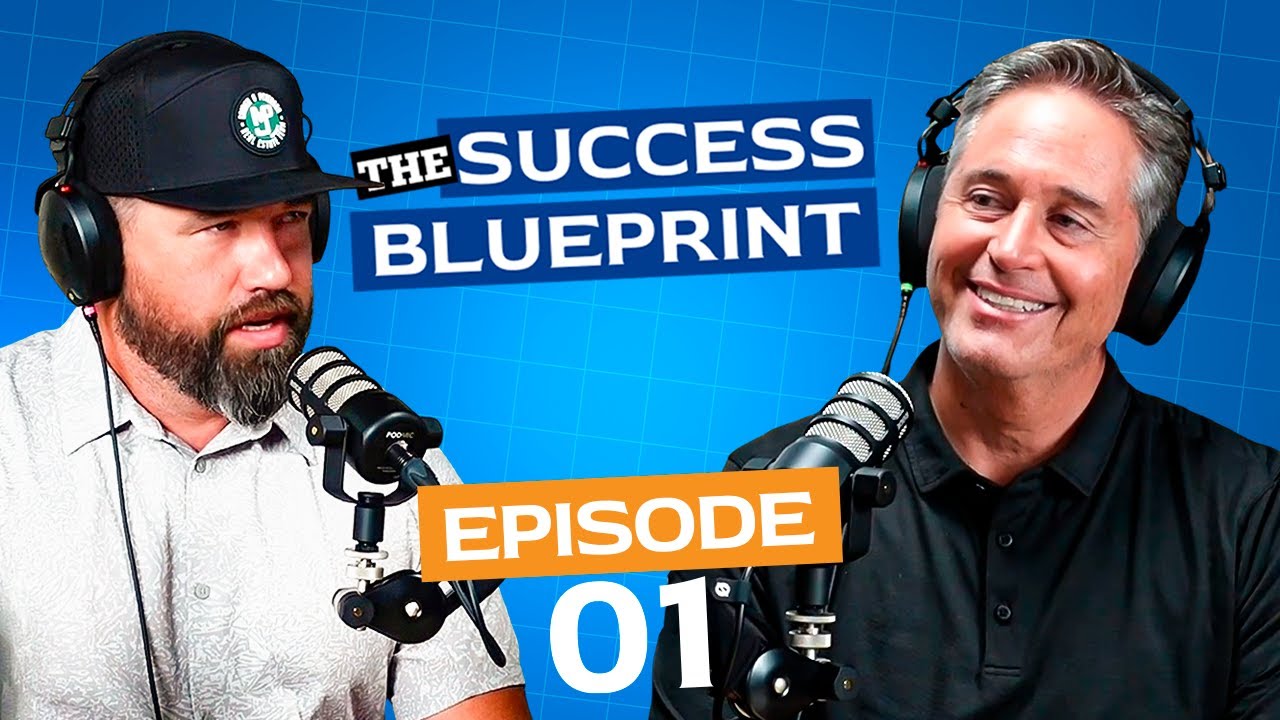
What does it take to build a top-producing real estate team in East Idaho when every traditional path wasn't an option? In the debut episode of The Success Blueprint Podcast, Jason Grider sits down with his business partner Morgan Peterson for a candid, unfiltered conversation about the mindset, sacrifice, and stubborn consistency that turned a self-described C-minus student into one of the most respected team leaders in the Idaho Falls real estate market.
Morgan opens up about growing up with a deeply entrepreneurial father who taught him the difference between assets and liabilities long before most kids understood what a mortgage was — a philosophy closely echoed in Rich Dad Poor Dad that still guides how he invests today. From flipping his first home as a teenager (with his dad funding it just to get Morgan out of the house) to grinding through the 2008 market crash, his story is less about talent and more about refusing to quit.
After washing dishes, bussing tables, and spending two years on a telemarketing sales floor, Morgan landed in real estate almost by default — but it turned out to be exactly where he belonged. He walks through how those phone-calling skills translated directly into prospecting, how he scaled from 9 to over 90 transactions per year almost entirely through cold calls, and why he believes motion creates emotion when you're building momentum from scratch. For anyone curious about how the Grider & Peterson team was built, this episode is the origin story.
The conversation also gets personal. Morgan talks about the real cost of building a business — missed bedtimes, fewer lunches with his dad, the seasons where the pendulum swings too far from family — and how his late father's financial wisdom still echoes in every major purchase decision he makes. He reflects on the transition from grinding solo agent to team leader at eXp Realty, why he and Jason decided to partner up, and what it truly means to succeed — not just financially, but as a husband, father, and business partner.
Whether you're an agent curious about joining a team in East Idaho, a buyer or seller trying to get to know the people behind the name when you connect with Grider & Peterson, or an entrepreneur who needs to hear that the messy path is still a valid path — this episode is for you.
Topics covered in this episode:
- Growing up entrepreneurial: lessons from Morgan's father
- Flipping homes as a teenager in Idaho Falls
- Surviving and rebuilding after the 2008 real estate crash
- How a telemarketing background built the phone skills that grew his business
- Scaling from 9 to 90+ transactions per year through consistent cold calling
- Building team culture at Grider & Peterson Real Estate
- Work-life balance realities in real estate
- The asset vs. liability mindset applied to real estate investing in East Idaho
- Why being "unemployable" can be your biggest competitive advantage
Referenced or related resources:
- Rich Dad Poor Dad — Robert Kiyosaki
- National Association of Realtors (NAR)
- Keller Williams Realty
- eXp Realty
- The Success Blueprint Podcast — All Episodes
Transcript
Jason: I guess just to start — we want to talk a little bit about how we came together. How we've been partners for, what, six years now?
Morgan: A little over six. Yeah. It's gone by fast.
Jason: Real fast. So, partners for six years. You'd been in the industry for a long time, and I'd been in it about five years and needed a change. And you grabbed me in a parking lot.
Morgan: You came to the parking lot — I remember it was snowing — and I said, "Hey, before you do anything or change anything, talk to me."
Jason: And the only experience we had before that was a couple of dinners at a Keller Williams family reunion event. So, we've been together six years, we've got a great team, some awesome agents. It's been a lot of fun. Really, we just love seeing agents succeed. That's the goal. And success can be driven by learning from all kinds of people — not just other agents, but from every industry.
Morgan: The other thing is it's a lot more fun to succeed with others than on your own. I did real estate solo for close to fifteen years before we partnered. Having people around you — just really cool people — it makes the whole thing better. The relationships and friendships we've built over the last six years, that culture we've cultivated, that's probably the most fun thing we've built.
Jason: I agree. When everyone around you succeeds, you succeed. But truly seeing it change their lives — that's been something else. So, this episode is more focused on you, Morgan. In the spirit of total transparency — let's start from the beginning. What were some lessons or stories from your childhood that changed your trajectory?
Morgan: Good question. Growing up, I hated school and I hated structure — the authority that came with it. After high school I bounced around a few jobs: dishwasher, busboy, construction for a couple of months. Then there was an opportunity to work on a sales floor — telemarketing, actually — and I did that for two years. It was a lot of fun. Then things brought me back to Idaho when I was about twenty-one.
Jason: What were you selling?
Morgan: Business opportunities. It was fun, but there were some gray areas, which is part of why I stopped. Around that time I got let go. My dad looked at me and said, "You're just unemployable." And I was like, "Oh, great." But then he said, "No — it's okay. You just have to figure out how to do things on your own terms."
So I looked back at what I'd made the most money doing, and I'd flipped a couple of homes right out of high school almost by accident.
Jason: You were pretty young to be flipping homes. What happened there?
Morgan: My dad wanted me out of the house. I was what you'd call a failure to launch. One morning he took me to this house — it was in terrible shape — and said, "You're going to fix this up. I'll fund it and we split it fifty-fifty, but you're living here until it's done." It was not livable when I got there. My girlfriend Lacy and I spent about four or five months doing a complete gut and overhaul on it.
After that, I'd made pretty good money on two homes. My dad was still doing some real estate at the time — buying land, developing — and that nudged me toward it. My mom and siblings were all academically successful, all got degrees, and they were nudging me that direction too. But I was like, do I go to school, or do I go to school for two weeks and get a real estate license?
Jason: No brainer if you don't like school.
Morgan: Exactly. I thought, I can do anything for two weeks. Barely made it through, but I passed the test and got my license.
Jason: What was home like during those teenage years? It sounds like you were ready to get out, but maybe not quite.
Morgan: I definitely liked independence, but I was a failure to launch — that's honest. Even after we fixed that first house up, one morning I wake up and I hear this loud sound outside. I go out and my dad is pushing my dresser across the sidewalk toward my truck. I'm like, "What are you doing?" He goes, "Grab the other side and help me load it." That was the day I moved out. No warning. No clue.
My siblings were mostly older than me. My parents traveled quite a bit, so teenage years were pretty free. I just really enjoyed that independence.
Jason: So you finish the two-week course, you pass the test. What's next?
Morgan: I had no clue what I was doing. Looking back at agents who join our team now, I can see exactly what I was — I didn't really know what a listing was or how to work with a buyer. I jumped back into flipping houses because it was easier and not many people were doing it. Trial by fire. And the trial-by-fire approach really hurts when your friends and family start referring people to you and you're not ready.
Real estate is like a popularity contest — you get out there, but then you have to walk the walk and talk the talk. And I wasn't doing that at all. Word travels fast. I was probably the opposite of what makes a great agent at that point. This was mid-2000s.
Jason: And then?
Morgan: I was flipping some homes and then the market crashed in '08 and '09. Everything just stopped. The flip market around here went into the tank — homes that should have been profitable were just dropping. Before the crash, bank-owned homes were rare and nobody really wanted to touch them. I'd find a place that looked condemned, walk through it, see good bones, and turn it. After the crash, bank-owned inventory was everywhere and suddenly everyone was on the flipping train. Hard to compete.
So here I was — not selling many homes, not doing many flips, and I didn't know what to do. We'd just built a new house, which sounds crazy, and I was broke. A lot of my friends were heading to the oil fields in North Dakota, making good money, cashing checks every week. I thought about it, but then I looked at their work-life balance — home one week, gone three weeks — and saw what it was doing to them personally.
So I thought — there are people doing well in real estate. I already kind of know the business. Maybe I should just put more effort in and see what I can make of this.
I went into work and found the smallest office they had, squeezed a little Target desk in there, and just started dialing. I was with Keller Williams at that point — started with a mom and pop called Windstar, they merged into KW, and that's where things started to turn.
Jason: You had two kids and one on the way at that point.
Morgan: Two and one on the way. So I didn't have a choice. I just started making phone calls. And when you start getting a little momentum, it breeds more positive thoughts, more possibility. I'd make calls, lock down deals, learn the business a little better. After a while I thought — I've done this much and I'm not dead. I wonder how much more I can do.
That first real push — I sold nine homes. Then sixteen. Then twenty-five. In that stretch from nine to twenty-five, people around me started to notice. And then I just thought, if I can do twenty-five, maybe I can do more. It eventually built to the point where, right before you joined, we were doing around ninety transactions.
Jason: And that's when you grabbed me in the parking lot.
Morgan: I knew I needed help. I knew it was the "who" not the "what." Gary Keller always said — it's not a what you need, it's a who. And I thought you had the things I was missing.
Jason: I used to watch you walking laps around the KW building every single day. I finally realized that was your phone call time.
Morgan: My office was so small I could barely open the door with my chair in it. And I've always known that motion creates emotion — that's something from my telemarketing days. When you're on the phone, moving helps. So I'd walk the building making calls, come in at nine, leave at seven or eight, and just dial.
I'd ask myself: if you could make two hundred and fifty dollars an hour, what would you do? And I'd do anything for two-fifty an hour. In real estate, you can do that — but you have to do the work. So I sat and dialed and dialed. Real estate is a contact sport. As many at bats as you can get. I struck out constantly, but each time I'd ask what I could fix so it wouldn't happen again.
There is an expensive tuition that comes with building a real estate business — and it's not up front. We're still learning now. After thousands of transactions, things still come up we've never seen before.
Jason: You mentioned buying leads, door knocking, open houses. You chose phone calls and stayed consistent.
Morgan: I never door knocked. Not once. And I tried buying leads — I just always felt like I was working the first two weeks of every month just to pay for the lead source, hoping I could turn a profit the last two weeks. I hated that rat race. I wanted something more sustainable, more fun, and more profitable. That's kind of how we built the model we have now.
Jason: Throughout all of this — and we're calling this the Success Blueprint — success isn't just financial. It's relationships, family, spiritual. What did this season look like on that side of life?
Morgan: My dad would always want to have lunch — three days a week, sometimes four. As I got busier, it went from four days a week to maybe once or twice a month. There's a lot of good things you have to give up. I missed dinners, bedtimes, stories. But I knew it wasn't going to last forever.
As we started doing better financially, I was able to trade those quick lunches for real vacations together. I'd tell my family: if I grind hard for three months, we'll go to Disneyland. Or to Mesquite for a week. They bought into it. The blueprint honestly just comes down to sacrifice — I haven't found a way around that yet.
Jason: I've always said the pendulum has to come back. If it stays on one side too long, the other side deteriorates. The tricky thing with real estate is you're in a current — you can't just step out of it whenever you want.
Morgan: Exactly. People say be present at home when you're home, be present at work when you're at work. I love the theory. But if you're building a business and your phone rings at seven in the evening — what do you do? We've learned over time to help our clients understand we're not always available, and most good clients genuinely respect that.
Jason: So what prompted you to approach me in that parking lot?
Morgan: My dad was around sixty at the time. He had properties and projects he wanted us to work on together, and I didn't want to miss that window. But I also couldn't let the team down. I needed another me — or honestly someone better at the things I wasn't good at. I thought you had those things.
What's funny is that people who knew us both at the time were surprised we partnered, because we're so different in a lot of ways. But the more we got to know each other, the more we realized we're actually very similar — we just take different routes to the same goal. Different strengths, same direction. Like the Avengers.
Then about a year into the partnership, COVID hit — and then my dad passed away. It was one of those things we'd kind of unknowingly planned for. I was able to step in and help with his estate and get those projects moving, which has taken time but is now finally coming through. And we were able to keep the team intact and keep growing.
Jason: We also recently made a change to how our agents work — opening up to both buyers and sellers, moving away from the strict Keller Williams split model. Walk us through that.
Morgan: I'm fine not being the first to do anything new — that's just me. We had a model that worked, so we kept it. But over time we kept hearing from talented agents: "I'd join your team in a heartbeat, except I want to do both sides." We couldn't find a logical reason to say no to that anymore. When you brought it to me, I'd honestly been thinking the same thing.
Jason: I do still believe that specializing — buyers or sellers — is the most efficient way to work. People get sharper that way. But even agents who want to focus on buyers will have that one or two listings come along that they really want to handle themselves. So it makes sense to open it up, watch it closely, and see if people can maintain a high level doing both. And ultimately, whatever's better for the agents is better for the team. If you want to learn more about what it looks like to work with us, you can check out our Join Our Team page.
Jason: So from that first flip house to now — family has grown, the business has grown. What's going really well, and what are you still working on?
Morgan: One thing I've done well: when I started making money, I knew what it was like to be completely broke and I never wanted to go back. So I kept my personal expenses low and shoveled everything into real estate. At one point I had twenty-five grand and there was a one-bedroom house for twenty-five grand. I'd planned to buy a boat. But then I thought — the house will go up in value, the boat will go down. The house rents for six-fifty a month. Once it pays back the twenty-five grand, I can buy the boat with the cash flow. I never bought the boat, but I bought the house. That mindset — always thinking assets versus liabilities — came directly from my dad.
What I'm still working on: I've learned a lot through getting smacked over the head with a baseball bat in commercial real estate and commercial loans. I'd benefit from doing more research and mentorship on the bigger structured deals before jumping in.
And on a personal level — since my dad's passing, my work-life balance has swung the other way. I find myself always thinking about time, about losing time with loved ones. I'm working on being more purposeful, more intentional — with the team and with my family. That balance is still a work in progress.
Jason: One thing I noticed early in our partnership is that you genuinely care more about other people's success than your own. Is that always been part of who you are?
Morgan: The way I've always looked at it: if I can help ten people and make ten to fifteen percent of what they make, that's solid — because I'm helping them do more than they could've done alone. And I know what it's like to struggle and feel like no one wants to help. I also know what it's like to have someone reach a hand out to you. I want to be that person.
I want people to look back and think: he was honest, he was fair, he always looked out for my best interest. I feel like if you operate that way, you're going to be okay. Sometimes people take advantage of it — that's a price I'm willing to pay. Because at least I can never be the problem.
And honestly — it's a small town. I'd rather anyone I've ever done business with come up and be excited to see me rather than looking away trying to avoid eye contact.
Jason: Who else has been influential in your life beyond your dad?
Morgan: From the beginning — my high school principal, Roy Smith. I thought he was a pain at the time, but he was a really good man. Then obviously my wife, Lacy. She does a lot of behind-the-scenes work — managing books, taxes, all things nobody sees or credits her for — and she's the most patient person I've ever met. A lot wouldn't put up with the life that comes with building a business like this, and a lot of spouses don't share the same vision. She did, and she does.
Church leaders over the years. And Jason — honestly, it's not just business. We have a real friendship, and I learn a lot about business, real estate, being a dad and husband through that relationship.
Jason: And I'd say the same. So let's close it out. What do you hope people take from this episode?
Morgan: I hope people can see that not everything is easy. Success — whatever that means to you — takes real work. I was telling my wife recently: even having a great relationship takes so much work. You can find the most incredible person in the world, but you still have to work at it. Everything worth having takes hard work.
We see so many people who assume someone just got lucky or fell into money. But that doesn't mean they're happy. That doesn't mean you'd want to trade places with them. There's so much more behind the scenes.
Jason: Exactly. And I think that's the whole point of this podcast. We want people to get a deeper sense of who we are and what we're about. We'll bring in guests, we'll talk about what success really looks like across all areas of life. Learn more and listen to future episodes at griderpeterson.com/the-success-blueprint-podcast, or connect with us directly here.
Frequently Asked Questions
Q: Who is Morgan Peterson and what is his background in real estate? Morgan Peterson is co-founder and partner at Grider & Peterson Real Estate, based in Idaho Falls, Idaho. He began flipping homes as a teenager, earned his real estate license after a brief stint in telemarketing sales, and built his business largely through cold calling — scaling from 9 transactions to over 90 per year before partnering with Jason Grider. Today Morgan leads one of East Idaho's top-producing teams at eXp Realty, with a focus on team culture, investment-minded thinking, and helping both buyers and sellers navigate the Idaho Falls real estate market.
Q: How did Grider & Peterson Real Estate get started? The partnership between Jason Grider and Morgan Peterson came together when Morgan approached Jason in a parking lot after recognizing they had complementary strengths. Morgan had built a solo business to around 90 transactions per year and knew he needed a partner, not just more staff. The two had crossed paths at Keller Williams and quickly discovered that while their personalities differed, their values and goals aligned closely. You can learn more about the full team on the Who We Are page, or explore what it looks like to join the team.
Q: What is The Success Blueprint podcast about? The Success Blueprint is a podcast hosted by Jason Grider and Morgan Peterson of Grider & Peterson Real Estate. Each episode digs into the real stories behind building a career, a business, and a life — covering topics like entrepreneurship, real estate investing, team building, work-life balance, and what success actually looks like beyond the financial scoreboard. It's designed for agents, investors, and anyone building something from scratch. Find all episodes at griderpeterson.com/the-success-blueprint-podcast.
Q: What advice does Morgan Peterson have for new real estate agents? Morgan's core advice is simple: real estate is a contact sport, and consistency with outreach — especially phone calls — is what builds a sustainable business. He cautions against relying too heavily on purchased leads, which can trap agents in a cycle of working to cover costs rather than build equity in their relationships. He also emphasizes that the early years require real sacrifice, that the learning curve has an expensive tuition, and that the most important thing is to keep improving after every mistake. If you're exploring a career in real estate or thinking about joining a team in East Idaho, visit the Grider & Peterson Join Our Team page or reach out directly.

Grider & Peterson Real Estate Team
Lead Agent | Grider & Peterson Team - EXP Realty LLC
or another way